Global Coalition Forum

Global Coalition for Social Justice Forum 5 November 2025, Doha, Qatar

Global Coalition for Social Justice recognized as a Key Platform to advance the Doha Declaration 

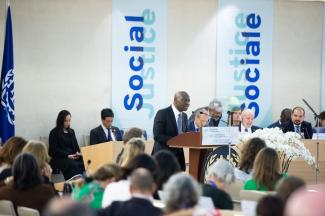
At the Global Coalition for Social Justice Forum, held on 5 November in Doha during the World Summit for Social Development, world leaders and partners urged stronger collective action to turn the Doha Declaration into reality.  The Forum provided a platform for fifteen partners to announce concrete initiatives developed under the Coalition, each aligned with and supporting a specific commitment of the Political Declaration adopted at the Summit. 


At the opening of the Forum, Qatar, the host country of the Summit announced its adhesion to the Coalition, becoming its 400th partner. Marking this milestone, Ali bin Saeed bin Samikh Al Marri, Minister of Labour, stated that this decision reflects “Qatar’s genuine commitment to strengthening international cooperation for equity in the world of work.” Through its participation, Qatar aims to help shape a new global agenda for social justice - one that integrates economic, social, and environmental policies, supports a just transition to a green economy, and extends social protection to the most vulnerable. This demonstrates Qatar’s determination to advance global cooperation on social development and translate the Political Declaration into concrete action.  

As Co-Chair of the Coalition’s Coordinating Group and co-convener of the Forum, Brazil, represented by Wellington Dias, Minister of Social Development and Assistance, Family and Fight against Hunger, stated that “we cannot achieve social justice without fighting poverty and hunger.” 

Brazil is prioritizing two key interventions: 

  • Promoting equitable food systems through its Global Alliance Against Poverty and Hunger
  • Leading the International Equal Pay Coalition (EPIC) as Chair for the current year.

These initiatives advance paragraph 2 of the Doha Declaration - which calls for a holistic approach to poverty eradication - and paragraph 11, reaffirming the need for gender equality and the empowerment of all women and girls. 

As a co-convener of the Forum, Switzerland, represented by Valérie Berset-Bircher, Ambassador and State Secretary, emphasized the need to align economic transformation with social justice by linking growth and equity. “We need to adopt a social justice lens to identify the policies and actions that need to be put in place to foster investment and growth” underlined Ms Berset-Bircher. Switzerland reaffirmed its commitment to two key interventions: 

  • Encouraging Sustainable Investment for Social Justice
  • Fostering Productivity Ecosystems for Decent Work and Social Justice. 

Both initiatives will help mobilizing resources contributing to the implementation of paragraphs 3 and 15 of the Doha Declaration, which call for inclusive and sustainable economic growth, full and productive employment, and decent work for all- essential foundations for poverty eradication and social inclusion. 

Representing employers, Roberto Suárez, Secretary-General of the International Organisation of Employers (IOE), reaffirmed the private sector’s support for the Coalition through initiatives contributing to shared prosperity, sustainable enterprises and inclusive employment, under the key interventions on:

  • Promoting Responsible Business Conduct and Skills Development
  • Fostering Social Dialogue
  • Encouraging an AI for social impact

Social Justice means equal opportunities, and that matters for business to move to a more sustainable and inclusive economy” said M. Suarez as stated in paragraph 3 of the Doha Declaration, which calls for harnessing the private sector’s contribution to job creation, decent work, and higher standards of living. 

Representing workers, Luc Triangle, General Secretary of the International Trade Union Confederation (ITUC), highlighted the need to foster more sustainable and inclusive societies, focusing on :

  • Supporting a Human Rights Economy
  • Advocating for Social Dialogue and social protection
  • Accelerating Gender Equality, including through the Equal Pay International Coalition
  • Promoting Living Wages

Those initiatives align with paragraph 3 of the Doha Declaration that reaffirm the global commitment to promote inclusive and sustainable economic growth, full and productive employment, and decent work for all, particularly through macroeconomic policies that foster job creation, decent work, and living wages. “The Doha Declaration is not just a text, but the start of something beautiful for billions of people who have very high expectations” underlined M. Triangle. 

Türkiye, represented by Prof. Dr. Vedat Işıkhan, Minister of Labour and Social Security, reaffirmed its commitment to advance:

  • A Just Transition towards Environmentally Sustainable Economies and Societies for All, as member of its Advisory Board. 

This initiative advances paragraph 9 of the Doha Declaration, which calls for action to address the adverse impacts of climate change, biodiversity loss, and environmental degradation that threaten social development, particularly in developing countries. Türkiye also reaffirmed commitments to extend on social protection, empowering women and youth, and to progress on fair wages, occupational safety and health, and public services for people on temporary protection. “The future of humanity depends not only on the wealth we accumulate, but more importantly on the humanity we share.”  concluded Prof. Dr. Vedat Işıkhan. 

Namibia, represented by Fillemon Wise Immanuel, Minister of Justice and Labour Relations, reaffirmed its commitment to employment and the extension of social protection under 

  • the Global Accelerator on Jobs and Social Protection for Just Transitions as a pathfinder country

This key intervention helps advancing the objectives of paragraph 3 of the Doha Declaration on promoting decent work and inclusive economic growth by implementing its national roadmap through a participatory process involving national stakeholders. M. Fillemon Wise Immanuel praised the Doha Declaration “as a hope for a better tomorrow.” 

The Netherlands, represented by Mariëlle Paul, Minister of Social Affairs and Employment, announced that the country will take: 

  • a leading role in the Steering Committee of the Living Wages Initiative
  • and on the promotion of social dialogue

This commitment aligns with paragraph 3 of the Doha Political Declaration, reaffirming the commitment to promote inclusive and sustainable economic growth, full and productive employment, and decent work for all-particularly through macroeconomic policies that foster job creation, decent work, and living wages. “This Social Summit is a catalyst for all of us to deliver concrete results towards achieving social justice and inclusive, sustainable development for all.” stated Minister Paul. 

The Philippines, represented by Warren M. Miclat, Undersecretary of the Department of Labor and Employment, reiterated its commitment to 

  • implement its national roadmap as a pathfinder country of the Global Accelerator on Jobs and Social Protection for Just Transitions
  • Participate in the Living Wages Initiative
  • Advocate for Just Transition towards Environmentally Sustainable Economies and Societies for All

He further noted that the Global Coalition for Social Justice is “an essential mechanism to deepen collaboration among ILO constituents toward fairness, inclusivity, and sustainability in the world of work”. Those interventions align with paragraph 3 and 9 of the Doha Declaration that aims to foster decent work and standard of living for the first one and actions to address the adverse impact of climate change and biodiversity loss for the other. 

Amitabh Behar, Executive Director of Oxfam International, announced Oxfam’s firm engagement to contribute to 

  • the Centre of Excellence on Inequalities

This is a timely initiative which fully aligns with their priorities  and paragraph 3 of the Doha Declaration, which underscores the urgent need to address poverty, unemployment, and social exclusion through multi-stakeholder partnerships, notably with civil society. “After a year of mobilization in Sevilla and now in Doha, we have much greater hope things will move into the right direction. (...) Now is the time to move to actions” concluded M. Behar. 

The European Commission, represented by Roxana Mînzatu, Executive Vice-President for Social Rights & Skills, announced its leadership in establishing

  • a Centre of Excellence on Inequalities, building on ongoing initiatives

This key intervention will be implemented through the EU Anti-Poverty Strategy, which aims to eradicate poverty by 2050. This initiative responds to paragraphs 2 and 4 of the Doha Declaration, which call for urgent action to combat poverty, unemployment, and social exclusion, while ensuring universal access to basic services including health care, education, safe drinking water, sanitation, housing, electricity, digital connectivity, and social protection. “When we invest in people, in skills, and in partnerships, we turn our promise of social justice into real change. The EU will continue to do its part,” underlined Ms. Mînzatu. 

India, represented by Mansukh Mandaviya, Minister of Labour and Employment, reaffirmed its commitment to the key intervention by 

  •  Supporting Responsible Business Conduct for Inclusive and Sustainable Societies

It aligns with paragraph 3 of the Doha Declaration, which calls for harnessing the private sector’s contribution to job creation, decent work, and higher living standards. “India is taking decisive steps to translate the ambition of the Doha Declaration into tangible progress. These actions will empower our private sector as a pivotal force for sustainable development, creating millions of dignified livelihoods and promoting equitable growth,” stated Minister Mandaviya. 

Finland, represented by Sanni Grahn-Laasonen, Minister of Social Security, confirmed the country’s engagement in 

  • Promoting Equal Pay International Coalition (EPIC) initiatives,
  • Encouraging youth empowerment,
  • Advocating for Just Transition towards Environmentally Sustainable Economies and Societies for All
  • Encouraging an AI for social impact. 

These align with paragraph 11 of the Doha Declaration, which reaffirms the global commitment to achieving gender equality and the empowerment of all women and girls. She underlined Finland’s commitment for “Social Justice and decent work at the heart of democratic societies.” 

Colombia, represented by Antonio Sanguino Páez, Minister of Labour, announced his country's commitment to:

  • be a pilot country under the key intervention Centre of Excellence on Inequalities
  • implement a national roadmap as a pathfinder country for the Global Accelerator on Jobs and Social Protection for Just Transitions

Colombia is advancing policies that address poverty, inequality, and informality, in alignment with paragraphs 2 and 3 of the Doha Declaration. Minister Sanguino stressed that Colombia is helping to shape “a renewed social contract and a new pact that will emerge from the declaration’s implementation.” 

Finally, Nada Al-Nashif, Deputy High Commissioner for Human Rights, presented the intervention on:

  • Encouraging a Human Rights Economy 

She emphasized that grounding economic and social policies in human rights and labour rights enables meaningful progress toward equality, justice, and sustainability. This aligns with paragraph 21 of the Doha Declaration, which calls for “strengthening international solidarity, upholding human rights, and a renewed commitment to multilateral action for social development.”  “The Global Coalition for Social Justice creates an opportunity for all stakeholders to work together in building economies that deliver prosperity more equitably and protect and promote human rights for all.” stated Ms Al-Nashif. 

Closing the forum, Mr. Li Junhua, Secretary-General of the Conference and UN Under-Secretary-General for Economic and Social Affairs and representative of the UN Secretary-General in the Coalition's coordinating group, underlined the significance of the Coalition's platform and thematic agenda to advance the implementation of the Political Declaration. He stressed: “This event clearly demonstrates that the Global coalition for social justice can serve as the engine to translate the guidance of the Doha political Declaration into tangible results. (...) Our work starts today." 

Global Coalition for Social Justice Forum : delivering the Political declaration through collaboration and action

The Global Coalition for Social Justice will take an active role in the upcoming Second World Summit for Social Development in Doha.

On 5 November 2025, during a Special Event dedicated to advancing the implementation of the Doha Political Declaration, partners of the Coalition will showcase concrete achievements and announce new commitments that drive progress toward greater social justice.

📍 Location: Qatar National Convention Center – Room 106
🕒 Time: 5 November 2025, 11:30–14:30 (AST)- 9:30-12:30 (GMT+1)

The Global Coalition for Social Justice Forum is co-convened by the State of Qatar, the Federal Republic of Brazil, the Swiss Confederation, and the International Labour Organization (ILO).

Chaired by the ILO Director-General, this high-level event will feature:

  • High-level addresses from global leaders;
  • A panel discussion with government representatives and social partners exploring how collective action drives meaningful impact;
  • Spotlight sessions highlighting partners’ contributions under the Coalition’s key interventions showcasing practical solutions, partnerships, and policy pathways to deliver on the commitments of the Doha Political Declaration

Bringing together Heads of State and Government, social partners, and senior officials from Coalition partner organizations, the Forum will underscore the Coalition’s role as a platform for coordinated, multi-stakeholder action - placing decent work and social justice at the heart of sustainable and social development efforts.

The event can be followed live on the ILO live page and the UNTV Webcast.

Full programme and list of speakers are available here

Social Justice takes us all” says ILO Director General Gilbert F. Houngbo 


Social justice is not an ethereal ideal, but a concrete necessity,” declared Dominican Republic President Luis Abinader, as he opened the second annual Forum of the Global Coalition for Social Justice, held alongside the 113th International Labour Conference in Geneva.

Addressing a diverse assembly of Ministers and senior officials, President Abinader emphasized that sustainable development hinges on the promotion of fairness and equity in the world of work. “If there is one area where that justice must take root,” he said, “it is in the world of work.”

The Forum marked a pivotal moment for the Global Coalition for Social Justice, bringing together more than 370 partners, including governments, workers’ and employers’ organizations, development banks, NGOs, and academic institutions. Since its launch in 2023, the Coalition has rapidly evolved into a dynamic platform for collective action to generate ground impact.

Brazil’s Minister of Labour and Employment, Luiz Marinho, representing both his government and the Coalition’s Coordinating Group as Vice-Chair, affirmed this shift toward implementation. “In 2025, we go from shared ambition to concrete development,” he said, highlighting the Coalition’s commitment to moving from principles to policy.

International Labour Organization (ILO) Director-General Gilbert F. Houngbo also praised the Coalition’s rapid progress, noting its transformation into a results-driven initiative. “We are seeing increasingly tangible results that reflect the cooperative vision that animates the Global Coalition,” Houngbo said. “Achieving social justice takes us all.”

Roberto Suárez Santos, Secretary-General of the International Organisation of Employers (IOE), called the Coalition “a concrete and dynamic platform and the consecration of Director-General Houngbo’s vision” to make social justice the heart of the global agenda.

Luc Triangle, General Secretary of the International Trade Union Confederation (ITUC), echoed this commitment to global cooperation. “This is a key time for history, with a threat to peace and social justice,” he warned. “The Global Coalition is a renewed commitment to multilateralism to reinforce the fight against inequalities.”

This year’s Forum focused on six high-impact areas through a series of discussions between partners to advance the social justice agenda particularly in the lead-up to the Second world Summit on Social Development in November 2025 in Qatar.

Read the record of proceedings in English here

Read the record of proceedings in Spanish here

Read the record of proceedings in French here

All the sessions can be viewed on the ILO live page here.

Voices of the Forum

Programme of the Annual Forum

Opening session, 09:15 – 10:30, Room XX 

The opening session, chaired by the President of the International Labour Conference (ILC), will feature high-level addresses and serve as a key moment to reflect on the achievements of the Global Coalition for Social Justice throughout 2024 highlighting its transition into a fully operational platform ready to deploy its key interventions in close collaboration with its partners. 

Interpretation will be provided in English, French, Spanish, German, Chinese, Russian, Arabic, Portuguese and international sign language. 

Follow on the ILO live page

Video statement by Dina Boluarte, President of Peru

Parallel sessions

Key intervention’s Spotlight: Living Wages, a driver of social and economic development

10:45 – 12:15, Room XX 

This panel will discuss the role that living wages can play in addressing broader systemic challenges including in-work poverty and income inequalities. It will also explore their potential to create more resilient local economies and the need to address the root causes of low pay. With increasing global attention to living wages, the session will showcase the initiative’s efforts to promote alignment with ILO principles for estimating and operationalizing living wages. This includes strengthening social dialogue and empowering wage-setting institutions. Partners will share their experiences and ambitions. Their contributions will reinforce sustainable development and social justice. 

Interpretation will be provided in English, French, Spanish, German, Chinese, Russian, Arabic, and international sign language. 

The panel will be moderated by Sharanjit Leyl. 

Follow on the ILO live page

List of speakers

Partners’ conversations: Fostering a just transition through social dialogue

10:45 – 12:15, Room XXIII 

The transition to environmentally sustainable, resilient economies is a defining challenge of this decade. Success depends not only on climate ambition, but on how transitions are governed and financed. Global efforts to address the climate crisis and build resilient economies rely on just transitions that promote inclusive growth, business development, and job creation ensuring that no one is left behind. Social dialogue is vital for building consensus and enabling trust and shaping fair solutions rooted in decent work. Despite its proven value, it remains underused in climate policies, finance mechanisms, and global cooperation. This session draws on recent initiatives and provides a platform to assess progress and strengthen social dialogue in climate and development frameworks. 

Interpretation available in English, Spanish, Portuguese and French 

Follow on ILO live page

List of speakers

Interactive thematic dialogue: Empowering youth for social justice

10:45 – 12:15, Partners’ zone  

Despite progress in the global youth unemployment rate, inequalities and decent work deficits continue to limit young people's opportunities in the labour market. One in five young people worldwide is not in employment, education, or training, and many are disengaging entirely. Two-thirds of these NEETs are women, pointing to the urgent need to address gender disparities. This thematic interactive dialogue will harness ILO constituents' expertise to promote more and better jobs for young people. It will also spotlight innovation, encourage intergenerational dialogue, and develop commitments for decent work. Outcomes will contribute to broader youth-focused efforts, including the ILO Global Youth Employment Forum in 2025. 

This discussion will be facilitated by ITC and will be in English only. 

List of speakers

Key intervention’s Spotlight: Responsible business for inclusive and sustainable societies

14:00 – 15:30, Room XX 

The Responsible Business Conduct agenda has become increasingly important in promoting an inclusive and comprehensive approach to sustainability across enterprises of all sizes. At the same time, there is growing recognition of the need to strengthen the social dimension of sustainable finance frameworks, including ESG criteria, and to foster models that balance social, environmental, and economic goals. This session will highlight how the private sector contributes to better jobs, inclusive growth, and social justice. It will examine the role of governments and social partners in creating an enabling environment for responsible business. 

Interpretation will be provided in English, French, Spanish, German, Chinese, Russian, Arabic and international sign language. 

Moderated by Sharanjit Leyl. 

Follow on the ILO live page

List of speakers

Partners’ conversations: Human Rights Economy

14:00 – 15:30, Room XXIII 

The Human Rights Economy (HRE) offers both a guiding framework and an operational approach for embedding human- and related labour rights - into economic and social policymaking. It promotes equitable access to resources, addresses inequality and discrimination, and calls for inclusive institutions, social protection and supports systems that uphold the rights of both service providers and recipients. It supports international commitments, informs global policy discussions, and develops tools to integrate rights into fiscal and governance systems. Aligned with the 2030 Agenda, the HRE offers a vision of justice, sustainability, and inclusion. It serves as a key instrument for achieving the Sustainable Development Goals through rights-based, transformative change. 

Interpretation available in English, Spanish and French 

Follow on the ILO live page

List of speakers

Interactive thematic dialogue: Leading change: AI for Social Impact

14:00 – 15:30, Partners’ zone

The rapid emergence of artificial intelligence (AI) holds transformative potential for societies, especially the world of work. Realizing this potential means balancing opportunities for job creation, innovation, and productivity with challenges related to job quality, working conditions, and employment relations. Addressing the “AI divide” within and between countries - driven by disparities in infrastructure, finance, and skills - is essential to ensure AI supports decent work and social justice. AI must contribute to more productive economies, resilient businesses, and empowered individuals. This session builds on outcomes from the February 2025 AI Action Summit in Paris, where partners launched the Network of Observatories on AI and Work. It reaffirms a shared commitment to strengthening this agenda. By exploring real-world AI use cases, the session will highlight both the opportunities and challenges of AI adoption.

This discussion will be facilitated by ITC and will be in English only.

List of speakers

Closing session 15:45 – 17:00, Room XX

The closing session of the Global Coalition for Social Justice, will be chaired by the President of the International Labour Conference and will serve to reflect on the outcomes of the Forum, featuring high-level addresses and providing a space for partners to reaffirm their commitments, outline concrete next steps and reinforce the Coalition’s collective ambition to advance social justice through impact-driven interventions at national, regional and global level. 

Interpretation will be provided in English, French, Spanish, German, Chinese, Russian, Arabic, Portuguese and international sign language. 

Follow on the ILO live page

Inaugural Forum
ILO

Inaugural Forum 2024

A call for stronger and more collective actions to advance social justice

On June 13, 2024, world leaders and partners of the Global Coalition for Social Justice gathered at the inaugural forum to call for stronger, more collective action in advancing social justice and to welcome the establishment of the Coalition as a key vehicle for achieving this goal.

Held on the sidelines of the ILO’s 112th Session of the International Labour Conference, the Coalition’s forum aimed to give a space for partners to exchange knowledge and experiences and to highlight concrete actions undertaken in support of social justice.

Never has social justice been so crucial for humanity

More than 1,200 representatives- head of States, partners, ILO constituents, tripartite delegations-participated to the Forum that intends to become an annual gathering. This year, the high-level dialogue was built upon the thematic areas that have been discussed with our partners in closed consultations such as building the resilience of societies; improving the coherence between economic and social policies; and fostering social dialogue for shared prosperity.

“Never has social justice been so crucial for humanity,” said Luiz Inácio Lula da Silva, President of Brazil, who was the keynote speaker at the Inaugural Forum, as co-chair of the Global Coalition for Social Justice Coordinating Group.

“No country can resolve the dilemmas that affect the international society on its own. We need to look for best practices and experiences wherever they are. The Global Coalition will be a central tool for building a transition with social justice, decent work, and poverty eradication,” he explained.

Established in November 2023, the Global Coalition has now more than 300 members- States, workers organization, employers, civil society, academia- a very diverse-yet unified-set of partners. 

Ramchandra Paudel, President of Nepal, stated that taking part to the Global Coalition was a way “to reaffirm our commitment to social justice, to reaffirm our faith in multilateralism.”

A clear roadmap to act

Speaking at the Forum, ILO Director-General, Gilbert F. Houngbo, called the Inaugural Forum, “the kick-off of a long journey, a journey that will bring all of us toward more and better social justice in the world.”

Moreover, the Director-General stressed the importance of transforming commitments to social justice into concrete actions, to bring tangible, positive and sustainable changes to people’s lives.

“The fruitful discussions we have had today must translate into action. And as we move forward, let us remember that our efforts are not just for us but for the generations to come,” Houngbo said. “Our roadmap is clear. We must act, and we must act at the country level.”

Coalition Forum 2025

The next edition of the Global coalition Forum will be held 12 June 2025 and will showcase the concrete transformative actions taken by our partners to build a world better tailored for social justice.

The exact date will be announced in due course and invitations will be send to all partners and interested parties.

Watch the video of the Inaugural Forum

Voice of partners (Inaugural Forum, June 2024)